Alphabet's 2026 annual meeting: the vote that was settled before it started
Alphabet's shareholders approved every item the Board proposed and rejected every item it opposed. Re-run the same ballot without the ten-vote Class B shares and two results reverse: a majority of unaffiliated voting power opposed the pay programme, and support for one share, one vote rises from 31% to an estimated 96%.
Alphabet held its 2026 annual meeting of shareholders on Friday 5 June, virtually, with fourteen items on the ballot and twenty-four separate line items to vote on. Holders of 12.95 billion of the 14.18 billion votes outstanding were represented, a turnout of 91.3%. Every management item carried. Every one of the ten shareholder proposals failed.
That outcome was arithmetically settled before the polls opened. Alphabet's 835.8 million Class B shares carry ten votes each, which gives insiders 58.9% of the voting power on 6.9% of the shares outstanding. Larry Page and Sergey Brin between them control 52.7%. The interesting question is therefore not whether items passed, but where the unaffiliated vote diverged from the certified result, and this year it diverged in three places: executive pay, the capital structure itself, and a shareholder-proposal agenda that has shifted from climate to artificial intelligence.
1. The full ballot scorecard
Support here is FOR divided by the sum of FOR, AGAINST and ABSTAIN. Broker non-votes of 580,489,723, which applied to every item except auditor ratification, are excluded from the denominator, which is how Alphabet tabulates them. Every item needed a majority of the voting power present and entitled to vote.
Three numbers stand out. Say-on-pay at 80.75% was the weakest management result. John L. Hennessy at 85.01% was the weakest director. And the proposal asking Alphabet to move to one share, one vote took 31.10%, more than three times the next shareholder item and the second consecutive year above 30%.
2. Who actually decided the ballot
Alphabet runs three share classes. Class A, listed as GOOGL, carries one vote. Class B, unlisted and held almost entirely by insiders, carries ten. Class C, listed as GOOG and used for all employee equity, carries none at all.
| Class | Shares outstanding | Votes per share | Total votes | % of shares | % of voting power |
|---|---|---|---|---|---|
| Class A, listed as GOOGL | 5,823,665,113 | 1 | 5,823,665,113 | 48.1% | 41.1% |
| Class B, unlisted, founder held | 835,779,041 | 10 | 8,357,790,410 | 6.9% | 58.9% |
| Class C, listed as GOOG | 5,456,336,540 | 0 | 0 | 45.0% | 0.0% |
| Total | 12,115,780,694 | n/a | 14,181,455,523 | 100.0% | 100.0% |
Class B converts one for one into Class A at the holder's option, but it is never sold into the market, so the wedge between capital and control is stable by construction. At the record date Page held 27.4% of the total voting power, Brin 25.3%, and all fourteen directors and executive officers together 54.3%, holding 92.2% of the Class B stock between them. BlackRock, the largest disclosed outside holder, had 2.5%.
Turnout arithmetic
Of 14,181,455,523 votes outstanding, 12,370,428,064 were cast FOR, AGAINST or ABSTAIN and 580,489,723 were broker non-votes, for 12,950,917,787 of voting power represented, or 91.32%. That leaves 1,230,537,736 votes unrepresented, all of them Class A.
3. Re-running the vote without Class B
Alphabet does not publish results by share class, so the split between insider and outside votes has to be estimated. The standard and conservative method is to assume every Class B share was voted and voted with the Board, which means FOR on management items and AGAINST on shareholder proposals. Subtract those 8,357,790,410 votes from the appropriate side and from the denominator, and what is left approximates how the unaffiliated Class A base voted.
Two outcomes invert
Say-on-pay falls from 80.75% as voted to an estimated 40.7% excluding Class B. On that basis a majority of non-insider voting power opposed the executive pay programme.
Equal shareholder voting rises from 31.10% to an estimated 95.9%. Support for retiring the dual class structure is close to unanimous among the shareholders who supply the capital.
The estimate also reframes several results that look comfortable as certified. Auditor ratification drew 3.75% against as voted but an estimated 10.9% of the non-Class B vote. The equity plan amendment drew 9.55% against as voted but an estimated 29.9%. Hennessy's re-election, 85.01% as certified, falls to an estimated 53.8%.
4. Proposal 1: the board
All ten nominees were elected, and the slate was identical to 2025. Alphabet applies a majority voting standard: a nominee failing to win a majority of the voting power present must tender a resignation for the Governance Committee to review. No nominee came close. Cumulative voting is not permitted.
| Director | Age | Director since | Years | Indep. | Committees | For (m votes) | Against (m votes) | Support 2026 | Support 2025 | Change (pp) | Excl. Class B |
|---|---|---|---|---|---|---|---|---|---|---|---|
| Larry Page | 53 | 1998 | 28 | No | Exec (Chair) | 12,105 | 254 | 97.85% | 80.87% | +16.98 | 93.4% |
| Sergey Brin | 52 | 1998 | 28 | No | Exec | 12,127 | 232 | 98.03% | 97.99% | +0.04 | 93.9% |
| Sundar Pichai | 53 | 2017 | 9 | No | Exec | 12,220 | 138 | 98.79% | 98.77% | +0.02 | 96.3% |
| John L. Hennessy | 73 | 2004 | 22 | Yes | Gov (Chair) | 10,516 | 1,833 | 85.01% | 83.35% | +1.67 | 53.8% |
| Frances H. Arnold | 69 | 2019 | 7 | Yes | Gov | 11,126 | 1,228 | 89.94% | 90.04% | (0.10) | 69.0% |
| R. Martin Chávez | 62 | 2022 | 4 | Yes | Audit, R&C | 12,239 | 118 | 98.94% | 99.30% | (0.36) | 96.7% |
| L. John Doerr | 74 | 1999 | 27 | Yes | Comp | 11,356 | 1,002 | 91.80% | 85.22% | +6.57 | 74.7% |
| Roger W. Ferguson Jr. | 74 | 2016 | 10 | Yes | Audit (Chair), R&C (Chair) | 12,185 | 172 | 98.50% | 99.03% | (0.52) | 95.4% |
| K. Ram Shriram | 69 | 1998 | 28 | Yes | Comp | 11,760 | 596 | 95.06% | 88.79% | +6.27 | 84.8% |
| Robin L. Washington | 63 | 2019 | 7 | Yes | Comp (Chair), Audit, R&C | 11,700 | 658 | 94.58% | 88.59% | +5.99 | 83.3% |
Dissent tracks tenure rather than independence. The four longest-serving directors, Page, Brin and Shriram since 1998 and Doerr since 1999, sit alongside Hennessy, who joined in 2004, at the bottom of the table. The two most recently appointed independents, R. Martin Chávez and Roger W. Ferguson Jr., both cleared 98.5%.
The board runs five standing committees. Audit is the working committee, with thirteen meetings and eight written consents in 2025. The Risk and Compliance Committee was created in October 2025 and met once. The Leadership Development, Inclusion and Compensation Committee met five times and acted by written consent eighteen times, a ratio that sits awkwardly beside the say-on-pay result. The Executive Committee, made up of Page, Brin and Pichai, did not meet at all.
5. Proposals 2 to 4: auditor, equity plan and pay
| # | Management proposal | For (m) | Against (m) | Abstain (m) | Broker non-votes (m) | Support | Excl. Class B |
|---|---|---|---|---|---|---|---|
| 2 | Ratify Ernst & Young LLP as auditor (FY2026) | 12,452 | 486 | 13 | none | 96.15% | 89.1% |
| 3 | Amend 2021 Stock Plan: +200,000,000 Class C shares | 11,172 | 1,181 | 17 | 580 | 90.31% | 70.1% |
| 4 | Say-on-pay on NEO compensation (advisory, triennial) | 9,989 | 2,334 | 48 | 580 | 80.75% | 40.7% |
Executive pay
Alphabet holds its say-on-pay vote every three years and its say-when-on-pay vote every six, so the next advisory vote on compensation does not fall until 2029. That infrequency is part of why the vote matters: shareholders get one opportunity in three years to register a view, and 18.86% of the votes cast used it to object.
| Officer | Salary | Stock awards | All other | Total 2025 | Total 2024 | Change |
|---|---|---|---|---|---|---|
| Sundar PichaiCEO, Alphabet & Google | 2,007,692 | 0 | 8,898,387 | 10,906,079 | 10,800,694 | +1% |
| Anat AshkenaziSVP, Chief Financial Officer | 1,003,846 | 30,171,070 | 84,115 | 31,259,031 | 49,978,135 | (37%) |
| Ruth M. PoratPresident & Chief Investment Officer | 1,003,846 | 28,123,532 | 11,750 | 29,139,128 | 30,166,427 | (3%) |
| Philipp SchindlerSVP, Chief Business Officer, Google | 1,003,846 | 40,577,554 | 620,151 | 42,201,551 | 47,024,009 | (10%) |
| Kent WalkerPresident Global Affairs; Chief Legal Officer | 1,003,846 | 28,123,532 | 11,750 | 29,139,128 | 30,162,760 | (3%) |
Four officers sit in the $29m to $42m range on largely time-vesting stock units. The SVP cash bonus was discontinued in February 2025 and its $2.0m target rolled into performance units, with transitional grants of $2.67m to $3.67m each to hold target pay flat; 2026 is the final year of that transition. Sundar Pichai's headline $10.9m is salary plus $8.90m of other compensation, overwhelmingly personal security and aircraft use, and understates realised pay because it excludes equity granted in earlier cycles. The CEO pay ratio is 35 to 1, low for a US mega cap, but only because Alphabet's median employee earned $310,826 in 2025.
The equity plan
Proposal 3 added 200 million Class C shares to the 2021 Stock Plan, which shareholders have now amended at the 2022, 2023 and 2026 meetings.
| Amended 2021 Stock Plan, Class C | Shares | % of shares outstanding |
|---|---|---|
| Outstanding GSU and PSU awards at 31 Dec 2025 | 281,490,604 | 2.32% |
| Available for future issuance | 534,281,345 | 4.41% |
| Newly authorised at the 2026 meeting | 200,000,000 | 1.65% |
| Total overhang after approval | 1,015,771,949 | 8.38% |
The denominator is 12,115,780,694 shares across all three classes at the record date. FY2025 stock-based compensation expense was $24.95bn, and buybacks of $45.71bn more than offset issuance. Because only Class C shares are issued under the plan, equity pay dilutes economic ownership every year without moving control by a single vote.
The auditor
| Fee category | 2024 | 2025 | % of 2025 total | Change |
|---|---|---|---|---|
| Audit fees | 31,130 | 37,900 | 55.2% | +21.7% |
| Audit-related fees | 11,767 | 9,506 | 13.8% | (19.2%) |
| Tax fees | 1,386 | 1,894 | 2.8% | +36.7% |
| All other fees | 21,229 | 19,400 | 28.2% | (8.6%) |
| Total fees | 65,512 | 68,700 | 100.0% | +4.9% |
Non-audit fees, meaning audit related, tax and other, were $30.8m of $68.7m, or 44.8% of the 2025 total. That is down from 52.5% in 2024 but still high against the 20% to 30% typical of large cap US issuers. The direction of travel is favourable, with audit fees up 21.7% to $37.9m while all other fees fell 8.6%. Ratification is the only routine item on the ballot, so brokers may vote uninstructed shares, which is why Proposal 2 carries no broker non-votes and a larger denominator than everything else.
6. Proposals 5 to 14: ten shareholder proposals
| # | Proposal | Lead proponent | Theme | For (m) | Against (m) | Support 2026 | Support 2025 | Excl. Class B |
|---|---|---|---|---|---|---|---|---|
| 5 | Enhanced disclosure on climate goals | Trillium ESG Global Equity Fund (lead) | Climate | 907 | 11,427 | 7.33% | 8.19% | 22.6% |
| 6 | Report on water usage and AI development | Inspire Investing, LLC | AI / Env | 185 | 12,131 | 1.50% | n/a | 4.6% |
| 7 | Equal shareholder voting (one share, one vote) | NorthStar Asset Mgmt Pension Plan; Mercy Investment | Structure | 3,847 | 8,503 | 31.10% | 30.63% | 95.9% |
| 8 | Viewpoint diversity risk report | National Center for Public Policy Research | Anti-ESG | 19 | 12,325 | 0.16% | n/a | 0.5% |
| 9 | Report on politicized content moderation | Bowyer Research for The Heritage Foundation | Anti-ESG | 26 | 12,299 | 0.21% | n/a | 0.6% |
| 10 | Report on impact of U.S. immigration policy | SOC Investment Group | Workforce | 225 | 12,098 | 1.82% | n/a | 5.6% |
| 11 | Report on data privacy governance | Zevin Asset Mgmt for D. & G. Bergman | Privacy | 744 | 11,588 | 6.01% | n/a | 18.5% |
| 12 | AI board oversight in Audit Committee charter | SHARE for Pension Plan of United Church of Canada | AI | 461 | 11,863 | 3.73% | n/a | 11.5% |
| 13 | Report on AI-generated misinformation | Vancity Investment Management | AI | 1,146 | 11,180 | 9.26% | n/a | 28.6% |
| 14 | Report on AI data usage oversight | National Legal and Policy Center | AI | 1,511 | 10,807 | 12.21% | 12.31% | 37.6% |
Alphabet faced twelve shareholder proposals in 2025 plus one presented from the floor, so the count fell from thirteen to ten. The subject matter, however, turned over almost completely, and five patterns are worth drawing out.
- One structural proposal dominates. Equal voting took 31.10%, more than three times the next item, after 30.63% in 2025. Stripped of Class B it is an estimated 95.9%.
- AI is the new centre of gravity. Four proposals were explicitly about AI, numbers 6, 12, 13 and 14, and a fifth on data privacy is AI adjacent. AI data usage oversight took 12.21% and AI misinformation 9.26%, both above the climate proposal. Together the four AI proposals drew 3.30bn votes in favour, more than any theme on the ballot except the capital structure.
- Climate support is eroding. The climate disclosure proposal fell from 8.19% to 7.33% even though the proponent tied it directly to data centre electricity demand rather than to abstract targets.
- Anti-ESG proposals are rejected outright. Viewpoint diversity at 0.16% and politicized content moderation at 0.21% were the two weakest results on the ballot, below 0.7% even excluding Class B, so the large index managers voted them down as decisively as insiders did.
- Repeat institutional filers dominate. Faith based, labour linked and values based funds, namely Trillium, Mercy, NorthStar, SHARE for the United Church of Canada, SOC, Vancity and Zevin, filed six of the ten. The remaining four came from conservative advocacy groups.
| Proposal | 2025 | 2026 | Change (pp) | 2026 excl. Class B |
|---|---|---|---|---|
| Equal shareholder voting | 30.63% | 31.10% | +0.47 | 95.9% |
| AI data usage oversight | 12.31% | 12.21% | (0.10) | 37.6% |
| Enhanced climate goal disclosure | 8.19% | 7.33% | (0.86) | 22.6% |
Under the SEC Rule 14a-8 resubmission thresholds, 5% after one year and 15% after three, all three clear the bar to return in 2027.
What each proposal asked, and the Board's stated answer
| # | The ask | Board's stated ground for opposing |
|---|---|---|
| 5 | Enhanced climate goal disclosure tied to data centre power demand | Existing environmental reporting already covers climate plans, progress and practices |
| 6 | Report on water use in AI development | Water strategy is already set out in sustainability reporting |
| 7 | Recapitalise to one share, one vote within seven years | The capital structure enables strategic flexibility and other safeguards apply |
| 8 | Independent committee to report on viewpoint diversity risk | A report on political or ideological metrics would misalign with business led leadership |
| 9 | Report on risks of politicized content moderation metrics | Moderation follows published policies with independent transparency reporting |
| 10 | Report on how US immigration policy and H-1B fees affect operations | Would constrain workforce management and expose sensitive strategic data |
| 11 | Report on governance gaps in user and cloud customer data handling | A multi layered privacy framework and extensive disclosure already exist |
| 12 | Write AI oversight into the Audit Committee charter | The Board already has technical depth and a Risk and Compliance Committee was created in October 2025 |
| 13 | Report on material risks from AI generated misinformation | Governance grounded in the AI Principles already mitigates the risk |
| 14 | Report on oversight of data used to train AI | AI and data governance frameworks provide comprehensive oversight |
Only one proposal can be said to have moved the company, and it moved before the vote rather than because of it. Proposal 12 asked for AI oversight to be written into the Audit Committee charter; Alphabet created a Risk and Compliance Committee in October 2025 and cited it in opposing the proposal. The proposal still drew 3.73% as voted, an estimated 11.5% of the non-Class B vote.
7. The FY2025 backdrop
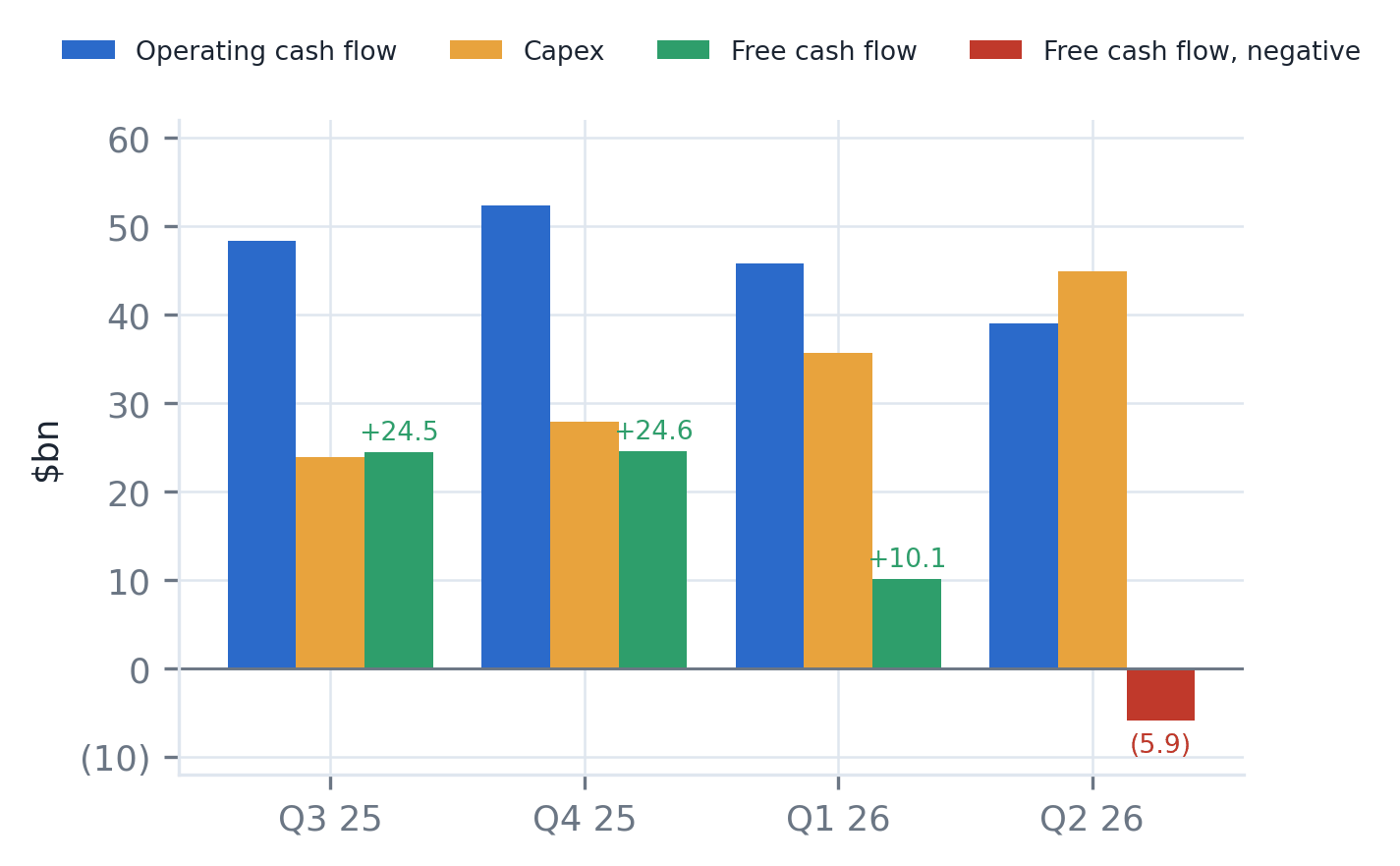
Capital expenditure of $91.4bn, up 74% in one year and 184% in two, sits underneath almost every shareholder proposal on this ballot. The water proposal, the climate proposal, the AI oversight proposal and the immigration proposal all argue from data centre build out. Against that, net income of $132.2bn and a 32.0% operating margin gave management the strongest possible position from which to reject all ten. Buybacks fell 27% to $45.7bn as capital expenditure absorbed cash, while the dividend introduced in 2024 grew 36% to $10.0bn.
| Segment | Revenue 2024 | Revenue 2025 | Growth | Op. income 2024 | Op. income 2025 | 2025 op. margin |
|---|---|---|---|---|---|---|
| Google Services | 304,930 | 342,721 | +12.4% | 121,263 | 139,404 | 40.7% |
| Google Cloud | 43,229 | 58,705 | +35.8% | 6,112 | 13,910 | 23.7% |
| Other Bets | 1,648 | 1,537 | (6.7%) | -4,444 | -7,515 | n/m |
| Alphabet total | 350,018 | 402,836 | +15.1% | 112,390 | 129,039 | 32.0% |
| Revenue line | 2024 | 2025 | Growth | % of 2025 revenue |
|---|---|---|---|---|
| Google Search and other | 198,084 | 224,532 | +13.4% | 55.7% |
| YouTube ads | 36,147 | 40,367 | +11.7% | 10.0% |
| Google Network | 30,359 | 29,792 | (1.9%) | 7.4% |
| Subscriptions, platforms and devices | 40,340 | 48,030 | +19.1% | 11.9% |
| Google Cloud | 43,229 | 58,705 | +35.8% | 14.6% |
| Other Bets and hedging | 1,859 | 1,410 | (24.2%) | 0.4% |
| Total revenues | 350,018 | 402,836 | +15.1% | 100.0% |
Alphabet level activities, a loss of $16.76bn in 2025, are not allocated to segments, so segment operating income exceeds the consolidated total. Diluted earnings per share rose from $8.04 to $10.81, and Google Cloud reached a 23.7% operating margin against 14.1% in 2024. Geographically, US revenue of $194.2bn was 48.2% of the total and EMEA $117.2bn was 29.1%, so roughly half of Alphabet's revenue sits outside the jurisdiction whose immigration and AI rules two of this year's proposals addressed.
8. What the meeting showed
A meeting with no contested outcome still produced three durable signals.
First, a majority of unaffiliated voting power opposes the executive pay programme, and cannot say so again until 2029. The triennial cadence means the objection registered in June 2026 has no further outlet for four years, while the transition of the SVP bonus into performance units runs through 2026 and total packages stay in the $29m to $42m range.
Second, that same base wants the dual class structure retired, by a margin that is near unanimous once founder votes are excluded. The proposal has cleared 30% as voted in two consecutive years, and its resubmission is effectively guaranteed.
Third, the shareholder-proposal agenda has completed its shift from climate to AI governance. Water use, board oversight, misinformation and data usage all outpolled the climate resolution, and the climate resolution itself declined. This is the first Alphabet ballot on which AI, rather than emissions or content policy, was the dominant theme.
None of this changes an Alphabet vote while Class B exists. But all three signals are now in the public record, two of the three are rising rather than fading, and they arrive alongside a capital expenditure programme that has nearly tripled in two years.
9. Method and sources
Vote totals are taken from Item 5.07 of the Form 8-K filed 11 June 2026. Proposal text, proponents, board recommendations, share counts at the record date, beneficial ownership, committee membership, compensation tables and audit fees come from the definitive proxy statement filed 24 April 2026. Financial figures come from the Form 10-K for FY2025 filed 4 February 2026, and 2025 comparatives from the Form 8-K filed 12 June 2025.
The excluding Class B figures throughout are an estimate, not a disclosure. Alphabet does not publish results by share class. For management items, FOR votes are reduced by the full 8,357,790,410 Class B votes; for shareholder proposals, AGAINST votes are reduced by the same amount; the denominator in both cases is votes cast less Class B votes. The estimate assumes every Class B share was voted and voted with the Board, which is conservative in the sense that any Class B vote against management would push the adjusted figures further in the direction described.
Sources: Alphabet Inc. Form 8-K filed 11 June 2026 (Items 5.02 and 5.07); DEF 14A filed 24 April 2026; Form 10-K for the fiscal year ended 31 December 2025, filed 4 February 2026; Form 8-K filed 12 June 2025. Filing data retrieved through sec-api.io.