Where to Find Insider Trades? Form 3, 4, 5 Explained
"Insider trade" refers to a mandatory disclosure that officers, directors, and large shareholders file every time they buy, sell, exercise options on, or are granted stock in their own company. Three forms carry this data: Form 3, Form 4, and Form 5. Together they're one of the cleanest, most current sources of information on what a company's own leadership is doing with its stock.
This blogpost explains insider trades, who needs to file and when, its content, relation to other filings, and how to get the data.
On this page:
What Are Insider Trades?
An insider transaction is a trade in a company's own stock made by someone the SEC classifies as an insider: an officer, a director, or a beneficial owner of more than 10% of a registered class of the company's equity securities. These transactions are reported under Section 16(a) of the Securities Exchange Act of 1934. It's a disclosure requirement: the majority of reported transactions are option exercises, scheduled sales, RSU vesting, and open-market purchases. They're public because the person making them has an insider relationship with the company.
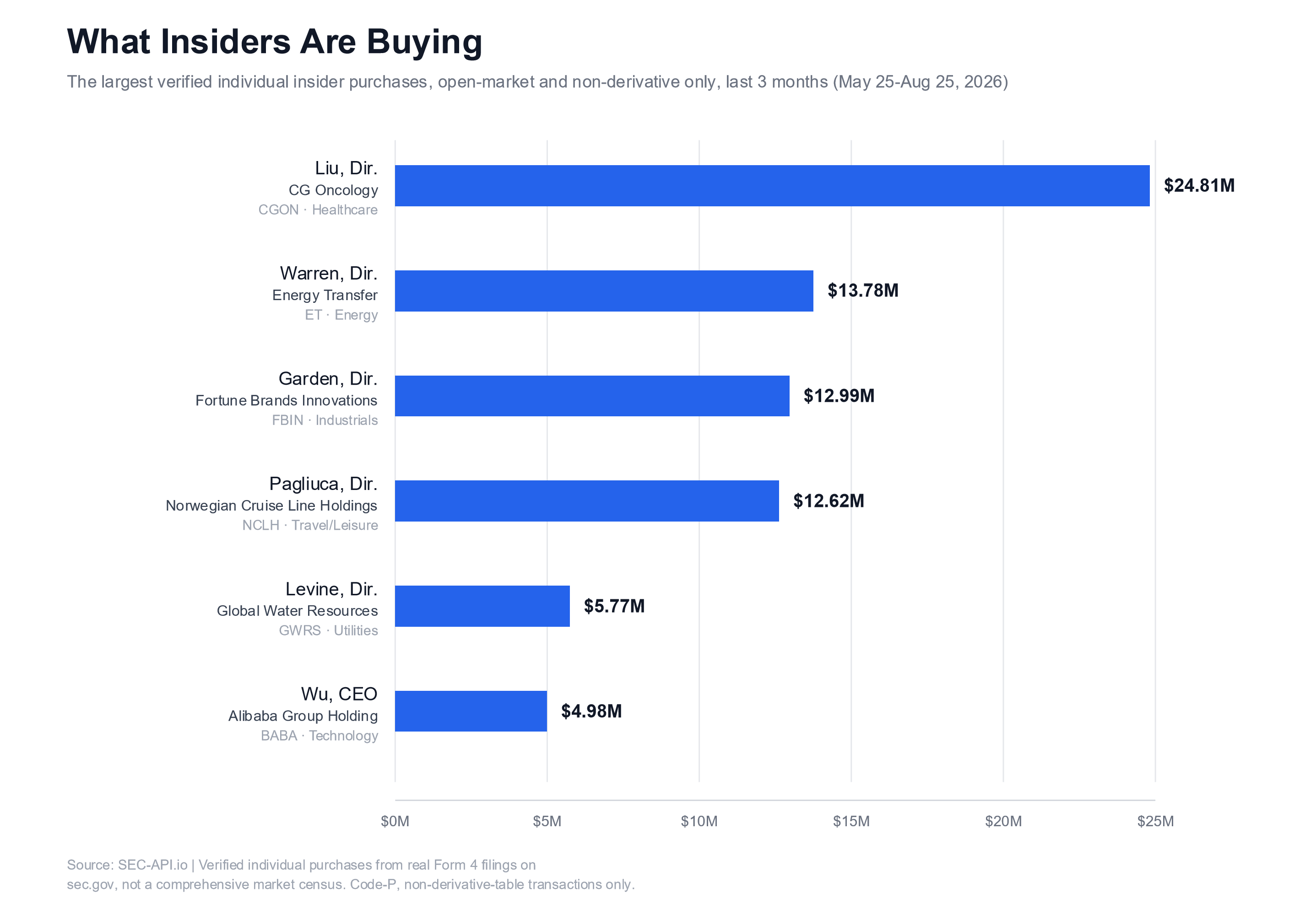
The below shows open-market and non-derivate insider purchases, derived via the SEC-API.io MCP Server. Those Insiders who intentionally increased their position; a signal often used by traders.
That's a different concept from illegal insider trading: trading on material nonpublic information, a securities fraud matter enforced by the SEC and DOJ. Section 16 disclosure obligations apply to every covered transaction regardless of whether nonpublic information was involved.
Who Needs to File, and When?
Three forms with three different triggers are all filed electronically through EDGAR in structured XML:
- Form 3: Initial Statement of Beneficial Ownership. Due within 10 days of becoming an officer, director, or 10%-plus beneficial owner. It's a snapshot, not a transaction: what the person already owns the moment they become an insider.
- Form 4: Statement of Changes in Beneficial Ownership. Due within two business days of a reportable transaction. This is the fast, transaction-level filing most people mean by "insider trading disclosure." The two-business-day window dates to the Sarbanes-Oxley Act of 2002. Before that, insiders had up to 10 days after the end of the month in which the transaction occurred, a far slower disclosure standard. The current deadline is set by Rule 16a-3, restated directly in the SEC's official Form 4 instructions: the form "must be filed before the end of the second business day following the day on which a transaction... has been executed."
- Form 5: Annual Statement of Changes in Beneficial Ownership. Due within 45 days of fiscal year-end. It catches transactions eligible for deferred reporting (certain small acquisitions, bona fide gifts) or anything that should have been reported on a Form 4 during the year but wasn't.
| Form | What It Is | Example Filing | What It Says |
|---|---|---|---|
| Form 3 | Initial ownership snapshot, due in 10 days | Broadridge Financial, Aug 2026 | New director Todd Diganci reported zero shares owned |
| Form 4 | Individual transaction, due in 2 business days | Tesla, June 2026 | Elon Musk exercised options on 303M+ shares, then had 17.5M withheld for taxes |
| Form 5 | Annual catch-all statement, due 45 days after fiscal year-end | Alphabet, Feb 2026 | Director John Hennessy's year-end holdings across stock classes and vesting stock units |
What's Inside a Form 4?
A Form 4 breaks each transaction into a small set of standardized fields:
- Security title: common stock, or a derivative like a stock option or RSU
- Transaction code: a single letter defining what happened:
P(open-market purchase),S(open-market sale),A(grant or award),M(exercise or conversion of a derivative),F(shares withheld to cover taxes or an exercise price),G(gift), among others - Shares and price: the amount transacted and the price per share (option exercises often show a $0 or strike price rather than a market price)
- Acquired or disposed:
Aif the insider's holdings increased,Dif they decreased - Ownership nature:
D(direct) orI(indirect, held through a trust, LLC, or similar entity, with a footnote explaining the arrangement) - Shares owned following the transaction: a running total, separately tracked for direct and indirect holdings
- The Rule 10b5-1 flag: since a 2022 SEC rule (Release No. 33-11138), Form 4 and Form 5 must indicate whether a transaction was made under a pre-arranged Rule 10b5-1 trading plan: a scheduling mechanism that gives insiders an affirmative defense against insider-trading liability by committing to trades on a set schedule, decided before any nonpublic information could influence the decision. In practice, this flag is what lets a reader tell a pre-scheduled, non-discretionary sale apart from one the insider chose to make in the moment, rather than having to assume one or the other.
Elon Musk's Form 4 for Tesla, filed June 17, 2026, shows several of these mechanics in one filing: a code-M transaction exercising a 2018 performance-based stock option for over 303 million shares at a $23.34 strike price, followed by a code-F transaction where roughly 17.5 million shares were withheld at $404.66 to cover the exercise cost, with footnotes explaining the award's history, two stock splits that adjusted its terms, and shares held indirectly through a revocable trust.
What Other Filings Are Worth Knowing?
What Other Ownership Disclosures Forms are Worth Knowing?
Form 3/4/5 aren't the only ownership disclosures. A few others often come up alongside them:
- Schedule 13D/13G: filed by anyone who acquires more than 5% of a registered class of a company's equity securities, per Rule 13d-1. That's a broader ownership threshold than Section 16's officer/director/10%-owner test, commonly used to track activist investors and institutional stakes.
- Form 144: a notice of a proposed sale of restricted or control securities by an affiliate, often filed shortly before the Form 4 that reports the sale actually happening. A useful leading indicator for tracking planned insider sales before they execute.
- Form 13F: filed within 45 days of each calendar quarter's end by institutional investment managers with discretion over $100 million or more in certain equity securities, under Section 13(f) of the Exchange Act. A quarterly snapshot of what funds hold, rather than a real-time transaction record like Form 4.
- Form ADV: the registration document investment advisers file with the SEC disclosing their business, fees, and conflicts of interest. It isn't an EDGAR filing. Advisers file it through the SEC's separate Investment Adviser Registration Depository (IARD) system, searchable via the Investment Adviser Public Disclosure website, but it's useful context for identifying the adviser behind a large Form 13F or 13D position.
Not every one of these comes from a person. Officers and directors filing Form 3, 4, or 5 are always individuals, but the "beneficial owner of more than 10%" trigger for those same forms can just as easily be crossed by an entity: a fund, holding company, or trust. Schedule 13D/13G works the same way at a lower, 5% threshold, filed by whoever crosses it, person or institution, which is why 13D/13G data mixes activist individuals with passive institutional stakes. Form 13F and Form ADV, by contrast, have no individual-officer equivalent: 13F is filed only by institutional investment managers with $100 million or more in assets under management, and ADV only by investment adviser firms registering with the SEC.
What about Form N-PORT, N-CEN, and N-PX?
Three more forms sit next to this group but answer a different question. Instead of disclosing who has taken a stake in an issuer, they describe what a registered fund holds, how it is organized, and how it votes its shares. All three are filed by entities, funds and their managers, and none has an individual-filer equivalent.
- Form N-PORT: a portfolio holdings report filed by registered management investment companies and by ETFs organized as unit investment trusts, per Rule 30b1-9. Money market funds and small business investment companies registered on Form N-5 are excluded. Filings are due within 60 days of the end of each fiscal quarter and contain one report for each month in that quarter. Where Form 13F covers a manager's positions in certain U.S.-listed equity securities, N-PORT covers a fund's full portfolio, including debt and derivative positions that fall outside the 13F securities list.
- Form N-CEN: the annual census report filed by every registered management investment company and unit investment trust, per Rule 30a-1, within 75 calendar days of the close of the fiscal year, or of the calendar year for unit investment trusts. It carries structured fund-level facts, including organizational details, share classes, service providers, and securities lending activity, rather than holdings or transactions. It replaced Form N-SAR, which was rescinded on June 1, 2018.
- Form N-PX: the annual proxy voting record. Registered management investment companies file it under Rule 30b1-4, and since the 2022 amendments every institutional investment manager required to file Form 13F files one as well, under Rule 14Ad-1, covering each shareholder vote under Sections 14A(a) and (b) of the Exchange Act: say-on-pay, say-on-frequency, and golden parachute votes. Both versions cover the twelve-month period ended June 30 and are due by August 31. N-PX is what closes the loop on Form 13F, showing not just what a manager held but how it voted those shares.
One caveat on N-PORT reporting frequency: amendments adopted in 2024 would require monthly filing within 30 days of month end, and much of the secondary commentary online still describes that as the current rule. It isn't. The SEC extended the compliance dates to November 17, 2027 for fund groups with $1 billion or more in net assets and May 18, 2028 for smaller groups, and a February 2026 proposal would scale the amendments back further, to a 45-day deadline with quarterly public disclosure. The quarterly filing schedule described above is the one in effect today.
Resources
On the rule
- Section 16(a) (15 U.S.C. § 78p) and Rule 16a-3: the statute and deadline behind Forms 3, 4, 5
- Section 13(f) (15 U.S.C. § 78m) and Rule 13d-1: the statutes behind Form 13F and Schedule 13D/13G
- SEC: Rule 10b5-1 amendments (Release No. 33-11138): the 2022 rule behind the 10b5-1 checkbox
- SEC: Form 3, Form 4, Form 5: official instructions for each form
Get the data via sec-api.io
- MCP Server: query EDGAR directly from AI assistants
- Insider Ownership & Trading API: full Form 3/4/5 history, real-time
- Data Browser: Insider Trading: the same queries, no code
- Form 13D/13G API: beneficial ownership data, above 5%
- Form 13F API: quarterly institutional holdings, $100M+ managers
- Form 4 dataset: bulk Form 4 history, since 2009